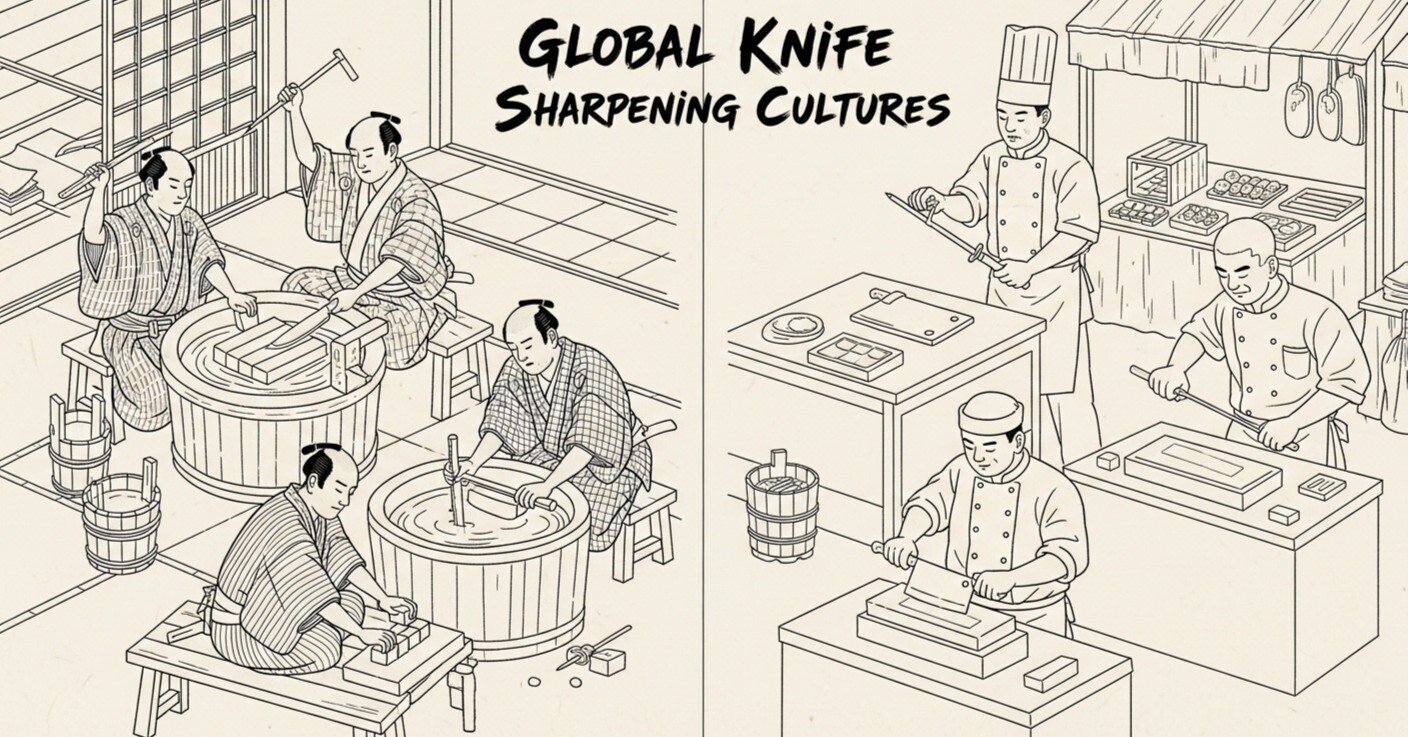
Japanese knives are celebrated worldwide for their razor-sharp edge and refined aesthetic. Behind that reputation lies something deeper than superior steel — it's a culture of sharpening, passed down through generations as a meaningful practice rather than a mere chore. Caring for a knife in Japan is understood as an act of respect for the craft itself.
In this article, we compare knife sharpening habits across Japan and 10 other countries, looking at both home kitchens and professional chefs — the tools they use, the routines they keep, and the values they reflect.
Japan
Cultural Background
The concept of mottainai — a deep reluctance to waste anything of value — runs through Japanese food culture. A knife is not just a tool; it's an extension of the cook's hand, treated with care and intention.
Home Cooks
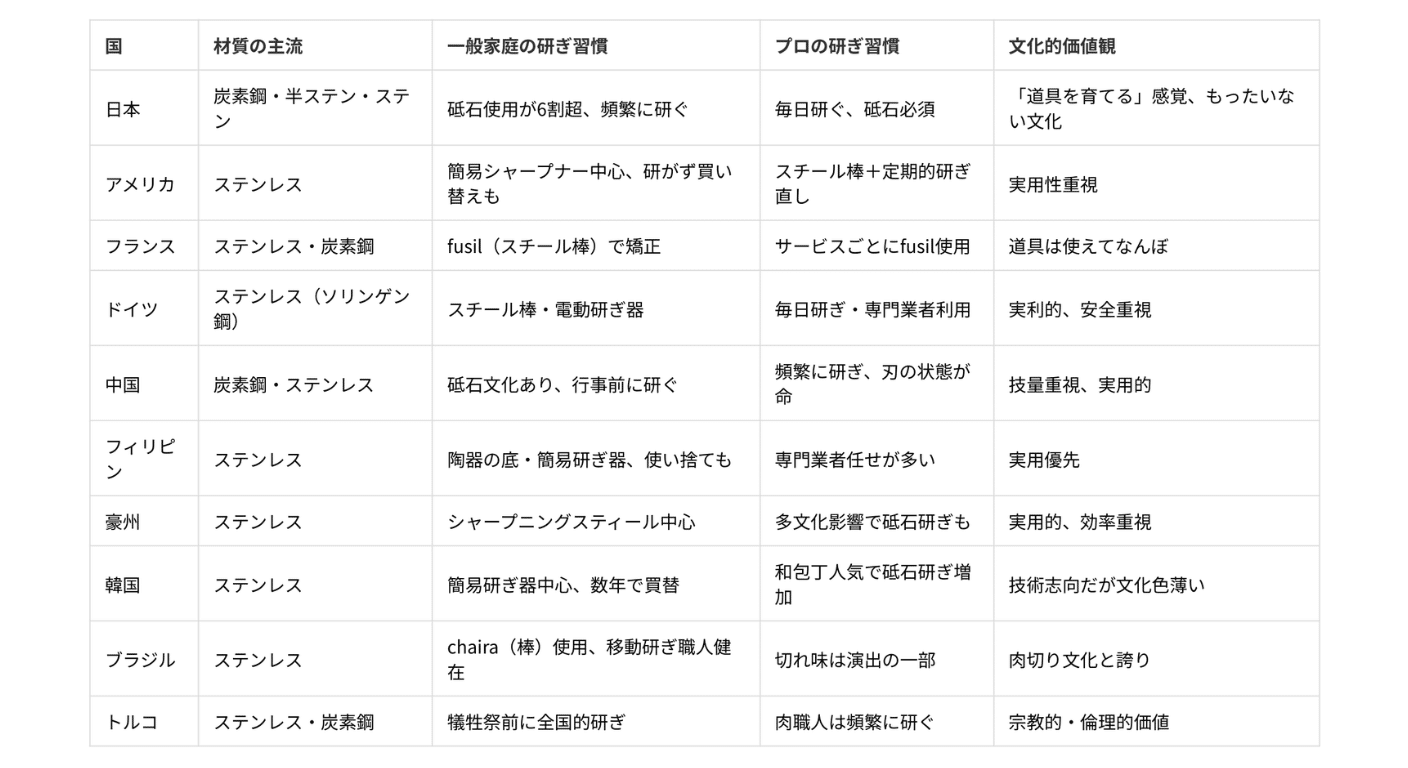
Historical surveys suggest that over 90% of Japanese households once sharpened their knives, with more than 60% using whetstones. While those numbers have likely declined, sharpening remains a living practice in many homes — especially among farming families and cooking enthusiasts. A good knife can last decades and be passed down through generations.
Professional Chefs
Sharpening on a whetstone is part of the daily routine. In Japanese culinary tradition, a knife is said to carry its own spirit — making sharpening both a technical skill and a form of discipline. A truly sharp blade preserves the texture and integrity of ingredients, making it central to the quality of the dish.
United States
Cultural Background
Practicality and efficiency drive knife care in American kitchens. The goal is maintaining function with minimal time investment.
Home Cooks
More than half of American households don't own any sharpening tool. When a knife dulls, many people simply continue using it — or replace it. Pull-through sharpeners and ceramic rods are the go-to solutions. In cities, mail-in sharpening services and pop-up sharpeners at farmers markets have grown in popularity.
Professional Chefs
The ethos is clear: a dull knife is a dangerous knife. Chefs hone blades with a steel rod before service and send knives to professionals or use whetstones every few months. Increasingly, American chefs are embracing Japanese knives and taking time to learn proper whetstone technique.
France
Cultural Background
French kitchens have a tradition of caring for tools over the long term. Knives were historically made from carbon steel, though stainless steel now dominates.
Home Cooks
The fusil — a sharpening steel — is a fixture in French kitchens, used to quickly realign the edge when it starts to slip. Full resharpening is typically handled by an electric sharpener or a professional. It's not unusual for a good French kitchen knife to stay in service for over a decade.
Professional Chefs
French chefs learn knife maintenance from the earliest days of their training. In fine dining, sharpening is often delegated to a specialist, while daily honing is done in-house. The wave of Japanese culinary influence has introduced whetstone sharpening to many chefs, and in three-star restaurants, knives are handled like precious objects.
Germany
Cultural Background
Home to Solingen — one of the world's great knife-making cities — Germany has a culture of investing in durable tools built to last a lifetime.
Home Cooks
The Wetzstahl, a sharpening steel, is used once or twice a week to keep edges aligned. Electric sharpeners are also common. High-end knives are maintained carefully; cheaper ones tend to be replaced rather than restored.
Professional Chefs
Chefs sharpen before every shift and use a steel rod throughout the day. Premium knives are sent to specialists or sharpened on whetstones. Mobile sharpening services that visit butcher shops and professional kitchens have become increasingly common.
China
Cultural Background
A well-known proverb captures the Chinese attitude: "Sharpening your knife won't delay the woodcutting." Maintaining your tools is considered essential preparation, not an interruption.
Home Cooks
The traditional caidao — a carbon steel cleaver — remains central to Chinese cooking, alongside growing use of stainless steel. In rural areas, whetstones and files are standard. City kitchens tend to use pull-through sharpeners or electric grinders. Demand for traveling sharpeners spikes before Lunar New Year.
Professional Chefs
The Chinese kitchen relies on one versatile cleaver to handle nearly every task, so keeping the blade sharp is non-negotiable. Chefs typically sharpen on a whetstone every two days and use a steel rod daily, often working on their knives after prep or closing.
Philippines
Cultural Background
Practicality shapes knife culture here, where cooking tools and agricultural tools often overlap.
Home Cooks
Stainless steel knives are common in cities, while in rural areas heavy carbon steel blades — used in the field as well as the kitchen — are sharpened on whetstones or files. A quick improvised method: running the blade along the unglazed bottom of a ceramic bowl.
Professional Chefs
Urban chefs increasingly turn to sharpening services, and some have adopted Japanese knives and whetstone techniques. Social media and cooking schools are raising awareness about the importance of knife maintenance among younger cooks.
Australia
Cultural Background
Australia's multicultural food scene draws freely from Japanese and European culinary traditions, including how knives are cared for.
Home Cooks
Chef's knives and santoku-style knives are popular, typically maintained with a honing rod or pull-through sharpener. Hobbyist interest in whetstone sharpening is growing, and professional sharpening services are widely available.
Professional Chefs
Many Australian chefs use high-end knives and have learned whetstone technique. At market stalls, on-the-spot sharpening services from skilled grinders are available. Maintaining sharp edges is viewed as part of kitchen safety.
South Korea
Cultural Background
Efficiency guides knife maintenance. Quick, practical methods are preferred over time-intensive ones.
Home Cooks
Stainless steel knives are standard, and many households don't own a whetstone. Pull-through sharpeners and honing rods are the default. Less expensive knives are replaced every few years rather than sharpened.
Professional Chefs
In upscale and Japanese-style restaurants, whetstone sharpening is the norm. As Japanese knives gain popularity in Korea, more chefs are investing in proper sharpening skills. Some are actively sharing their craft on social media.
Brazil
Cultural Background
Churrasco — Brazilian barbecue — elevates the knife to a near-ceremonial role. A sharp blade is part of the performance.
Home Cooks
Stainless steel is the standard. In churrasco culture, the chaira (a sharpening steel) is a constant companion. Rural cooks use whetstones; in cities, traveling sharpeners are a familiar sight in neighborhoods.
Professional Chefs
At a churrascaria, sharpening is part of the show. Blades are honed with a rod just before carving, and the knife is treated like a trusted partner — always cared for, always ready.
Turkey
Cultural Background
In Turkey, knife sharpening is intertwined with religious life, particularly around the Kurban Bayrami (Feast of Sacrifice).
Home Cooks
Carbon steel knives are gradually giving way to stainless, and in cities, hiring a sharpener is common. Nationwide demand surges dramatically in the weeks before Eid al-Adha.
Professional Chefs
Meat specialists use purpose-specific knives and sharpen them frequently. For significant occasions, hand sharpening is preferred. In the days leading up to religious festivals, knife preparation is treated with special care.
Closing Thoughts
Knife sharpening reflects the values of the culture it comes from — whether that means respecting a tool's lifespan, honoring a ritual, or simply getting the job done efficiently.
Japan's philosophy of mottainai and the idea of a knife as "an extension of the hand" may seem unusual from the outside — but to many around the world, it's quietly inspiring. At the same time, the practical, task-specific approaches found in other countries offer fresh perspective on how we relate to the tools in our kitchens.
However you care for your knives, there's wisdom to borrow from every tradition. With the right attention, a knife stops being just a tool — and becomes something closer to a partner.