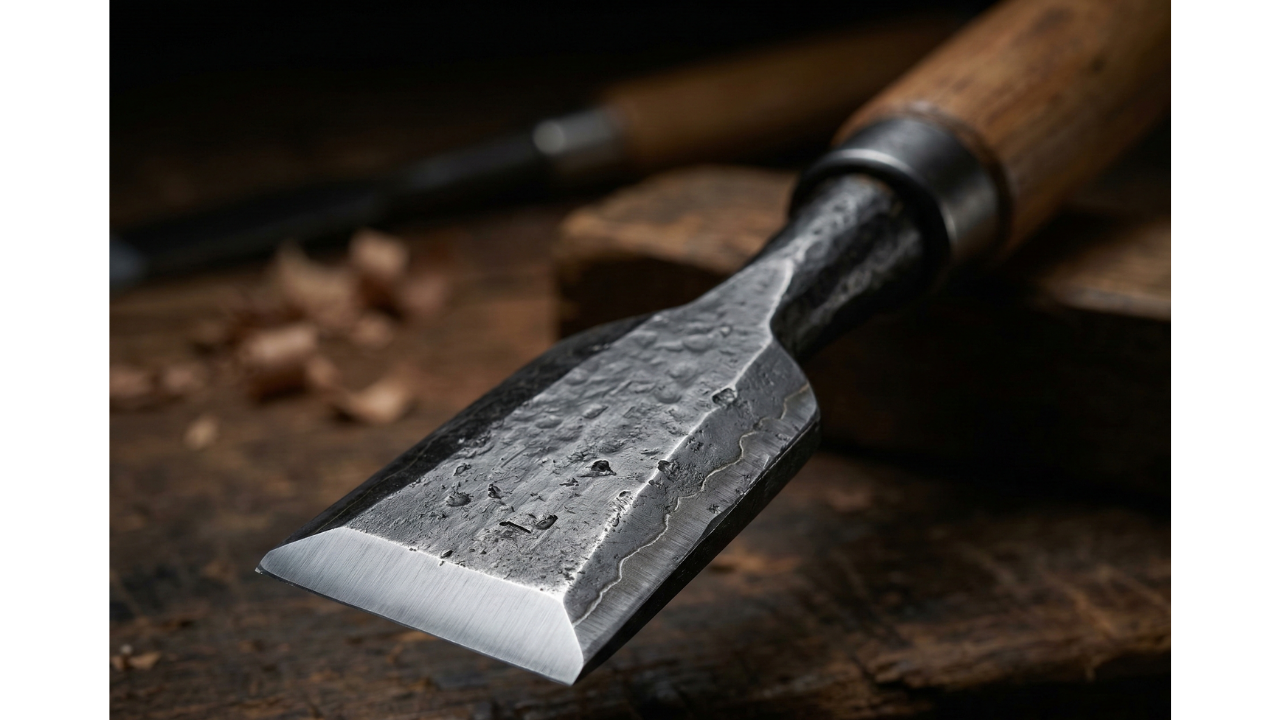
Japan is a country built from wood.
Roughly 70% of its landmass is covered in forest. For thousands of years, the Japanese built everything from wood — homes, temples, shrines, castles. While much of the world turned to stone and brick, Japan kept building with timber.
Horyuji Temple, the oldest surviving wooden structure on Earth, was built around 1,300 years ago. It still stands. Through sweltering humid summers, freezing winters, and countless earthquakes, this wooden building has endured.
How?
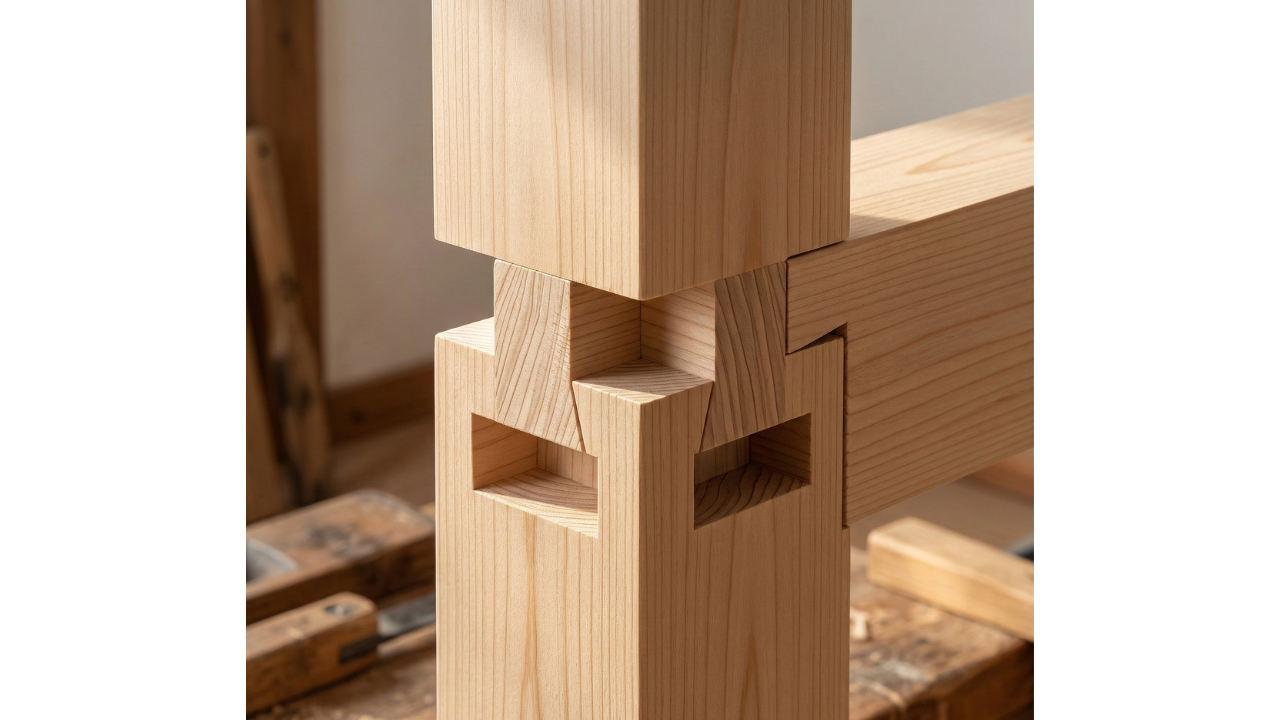
Japanese carpenters developed an extraordinary technique called kigumi — joining wood to wood without a single nail. Using interlocking joints known as tsugite and shiguchi, they created structures so precise that modern computer analysis still cannot fully replicate them. These joints give buildings a supple strength, absorbing the shock of earthquakes rather than resisting them.
But even the most skilled carpenter is nothing without the right tools.
A saw (nokogiri) to cut the wood. A plane (kanna) to shave it smooth. A chisel (nomi) to carve the joints. Each tool must be razor-sharp — because in Japanese woodworking, the sharpness of the blade determines the quality of the building, and ultimately, how long it will stand.
There is one small city in Japan that has been the spiritual home of these tools for centuries.
Miki. Population: about 70,000. A quiet place most people outside Japan have never heard of.
This is the story of how it became the capital of carpentry tools — and why it matters.
The Seed: Blacksmiths from Ancient Korea
Miki sits northwest of Kobe, in the Harima region of Hyogo Prefecture. It occupies a strategic position — close to the ancient capitals of Kyoto, Osaka, and Nara, and along the trade routes leading west toward the San'in and San'yo regions.
The story of metalworking in this area begins around the 5th century — Japan's Kofun period, an era of massive burial mounds and clan warfare.
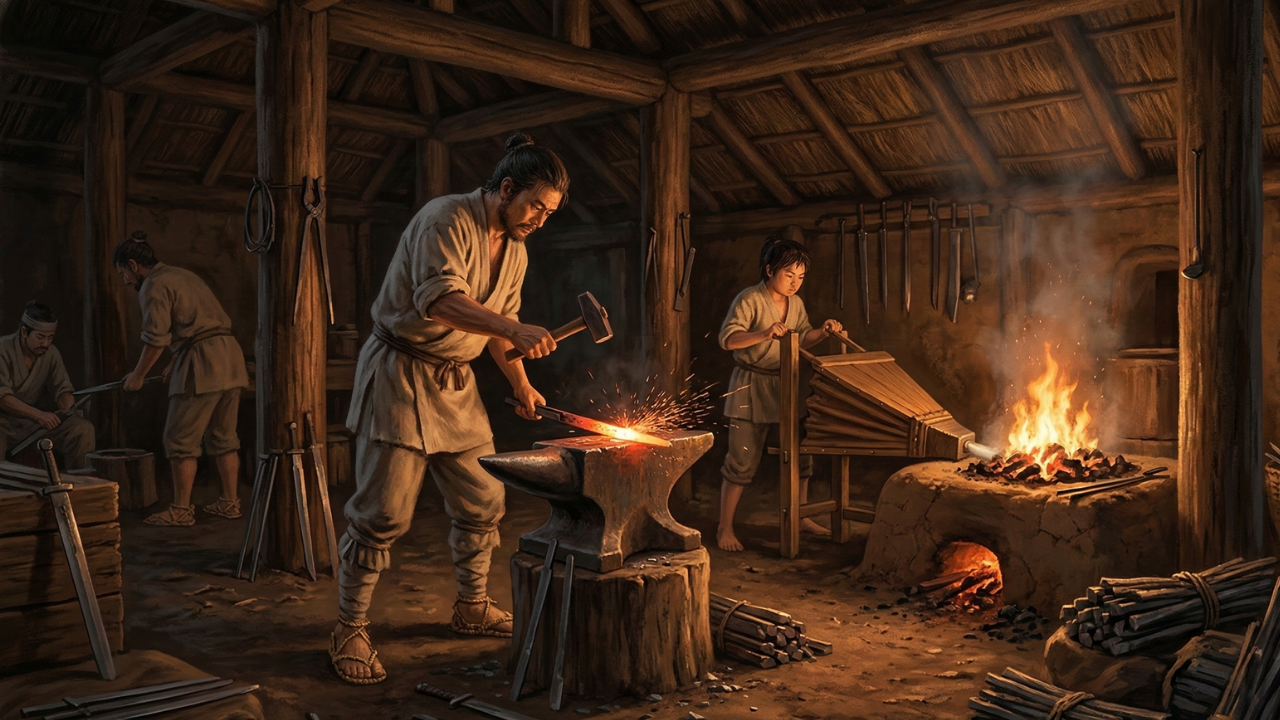
Around that time, a group of skilled metalworkers from the Korean kingdom of Baekje crossed the sea and settled in the Miki area. They were known as kara-kaji — Korean blacksmiths. In Miki, they encountered yamato-kaji, Japan's indigenous blacksmiths, and the two traditions merged.
Why Miki, specifically?
Geography tells the story. The Harima region had long been associated with ironworking. High-quality iron sand — the raw material for traditional tatara smelting — was found to the northwest, toward the mountains of the San'in region. Meanwhile, the great cities where iron was consumed — Nara, Osaka, Kyoto — lay to the east. Miki sat right at the crossroads.
The Harima no Kuni Fudoki, a geographical record compiled in the 8th century, mentions Ame-no-mahitotsu-no-mikoto, the deity of blacksmithing, in connection with this region. The land already had iron in its veins.
Korean technique fused with Japanese tradition. A new kind of forge was born. But this was still a quiet beginning — a seed planted in fertile soil. It would take a catastrophe to make it grow.
The Battle of Miki: A Siege That Destroyed Everything
1578.
Oda Nobunaga, the warlord who was unifying Japan by force, dispatched his most trusted general — Hashiba Hideyoshi, later known as Toyotomi Hideyoshi — to conquer the western provinces. Standing in his way was a young castle lord named Bessho Nagaharu, who held Miki Castle.
Nagaharu defected from Nobunaga's alliance and fortified himself inside the castle walls with approximately 7,500 soldiers, their families, and local Buddhist followers. He was waiting for reinforcements from the powerful Mori clan to the west.
Hideyoshi did not storm the castle. Instead, he chose a strategy of starvation.
His forces constructed over 40 siege fortifications around Miki Castle, connected by earthen walls stretching roughly 5.5 kilometers. Every supply route was severed. No food could enter.
The siege lasted nearly two years.
Inside the castle, soldiers ate their horses, then their dogs, then the bark of trees, then the roots of grass. Starvation claimed hundreds. The scene inside the walls was described as hell on earth.
In January 1580, with no hope remaining, Nagaharu accepted the terms of surrender: his own death, and that of his family, in exchange for the lives of his soldiers.
On his final night, he hosted a farewell feast with his family. Then he took his own life. He was 23 — some records say 29.
Before he died, Nagaharu composed a farewell poem:
Now I hold no bitterness toward anyone — knowing my life will stand in place of theirs.
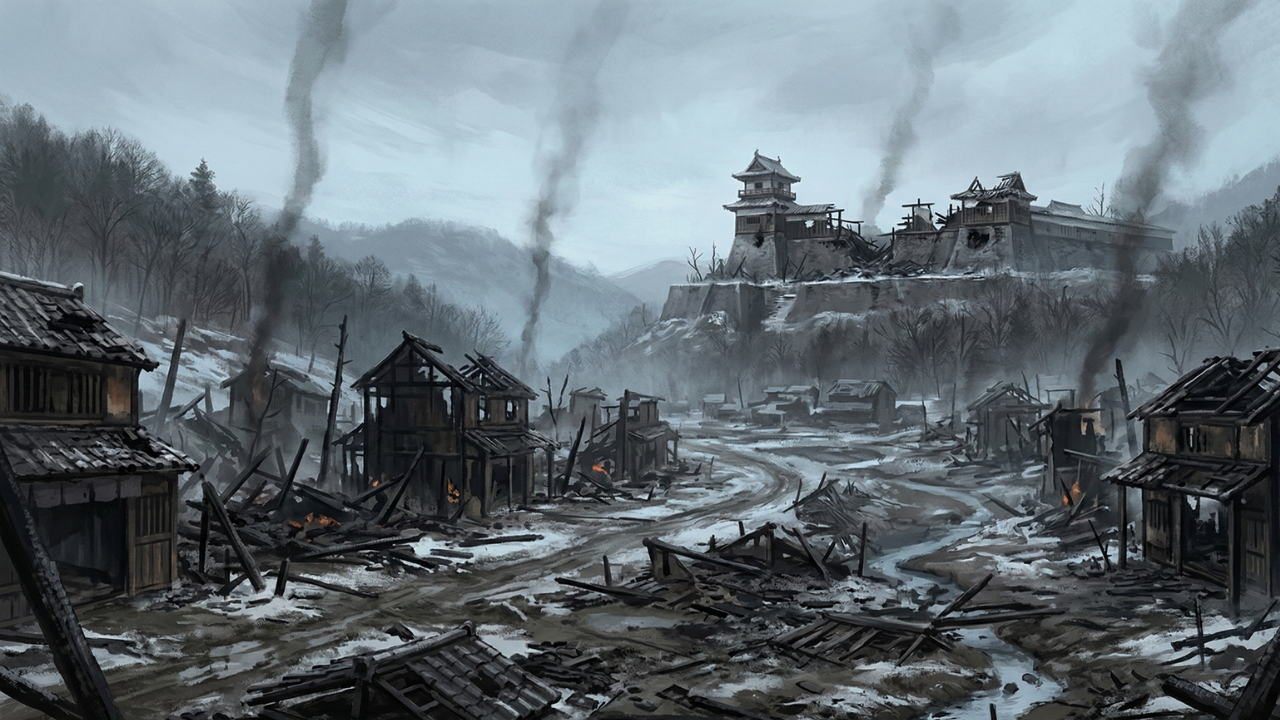
Miki was reduced to ashes. Every temple, every home, every trace of the old town — gone.
From Destruction, Creation: Hideyoshi's Rebuilding
When the battle ended, Miki was nothing.
But paradoxically, this total destruction is what transformed the city into Japan's toolmaking capital.
Hideyoshi initiated a rebuilding program. To draw people back to the devastated town, he introduced a tax exemption policy — a measure so generous that it continued well into the Edo period, lasting for generations.
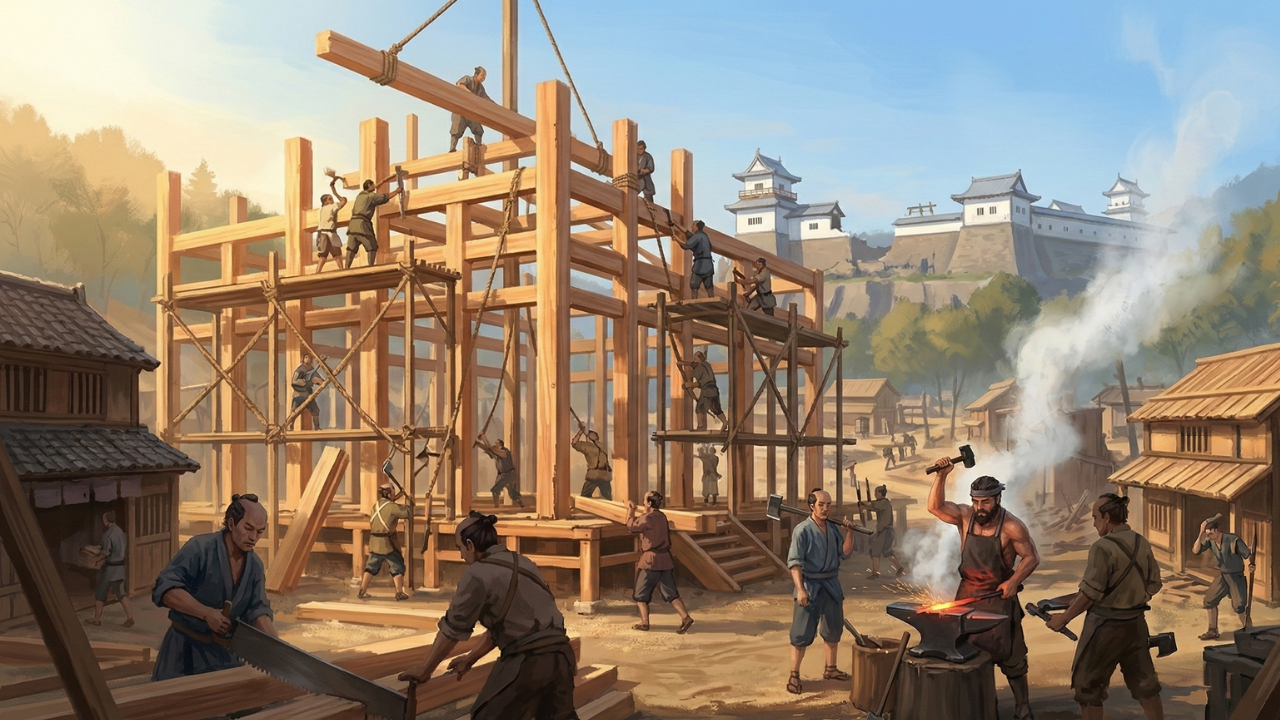
Rebuilding meant construction. Burned temples had to be rebuilt. Destroyed shrines had to be restored. Homes for returning residents had to be raised from the ground.
Carpenters came from across the region. And where carpenters go, blacksmiths follow — because carpenters need tools.
Miki already had 1,500 years of metalworking in its soil. Now it had enormous demand. Carpenters and blacksmiths worked side by side, day after day. The carpenter would say: I need a blade that holds its edge longer on this type of grain. The blacksmith would answer: Then I'll temper the steel differently. The tools were not designed in isolation — they were born from conversation, from the daily rhythm of rebuilding.
This is the origin of Miki's toolmaking tradition: tools shaped by the hands that use them.
The Traveling Carpenters Who Spread the Word
Eventually, the rebuilding was finished.
The carpenters who had gathered in Miki found themselves without work. They left for Kyoto, Osaka, and other cities, seeking employment. And when they arrived, the tools they carried caused a sensation.
The blades cut differently. The finish was different. Wood planed with a Miki blade came out so smooth it needed no further sanding. People began to say that Miki tools let the wood breathe.
The next time these carpenters traveled, they brought extra tools to sell. What began as a side business became a trade.
By the mid-18th century (the Horeki era, 1751–1764), dedicated middlemen had appeared to handle procurement and sales. They grew into wholesale merchants, and by 1792, five trading houses had formed a merchant guild. In 1803, direct trade with Edo (modern-day Tokyo) began — and Miki's tools spread across the entire country.
After the Meiji Restoration in the late 19th century, the introduction of imported steel streamlined production. Miki's merchants fanned out across Japan, and the city began producing Western-style tools alongside traditional ones. Exports followed.
After World War II, when Japan lay in ruins once again, the nation needed tools to rebuild. Miki answered the call — just as it had 400 years earlier after Hideyoshi's siege.
A town that rose from ashes in the 16th century helped a nation rise from ashes in the 20th. History, it seems, has a sense of rhyme.

Banshu Miki Uchihamono: A Living Tradition
Today, five categories of Miki-made tools hold the official designation of Banshu Miki Uchihamono — Traditional Craft Products of Japan, as recognized by the national government:
Nokogiri (saws). Nomi (chisels). Kanna (planes). Kote (trowels). Kogatana (utility knives).
Each tool is forged by hand through 14 to 21 individual steps — welding steel to iron, heating and hammering repeatedly, quenching, clay-coating, and finishing. One blacksmith, one blade, one process at a time.
Miki is still home to numerous small, often family-run forges. Each workshop specializes in specific tools, maintaining a tradition of high-mix, low-volume production. In an age of mass manufacturing, the principle remains unchanged: one craftsman facing one blade.
The quality speaks for itself. Miki tools are sought out not only by Japanese carpenters and woodworkers, but by professionals around the world who insist on the finest edge.
On the Same Line, 1,500 Years Long
The story of Miki's blacksmithing begins with a group of Korean craftsmen who crossed the sea 1,500 years ago.
A devastating war in the 16th century, paradoxically, brought carpenters and blacksmiths together in unprecedented numbers. The tools they forged in the process of rebuilding were carried across Japan by traveling carpenters, and the name "Miki" became synonymous with the finest hand tools.
That line continues today.
In Miki's workshops, the bellows still breathe, the steel still glows red, and the hammer still falls. Ichizo Honpo is one of those workshops — forging chisels on this same soil, carrying this same tradition forward.
Quietly. Steadily. Like a tree with 1,500 years of roots.