You often see the word Shirogami in descriptions of Japanese knives. Here is a short look at what it is, based on the manufacturer's published figures.
What Shirogami is
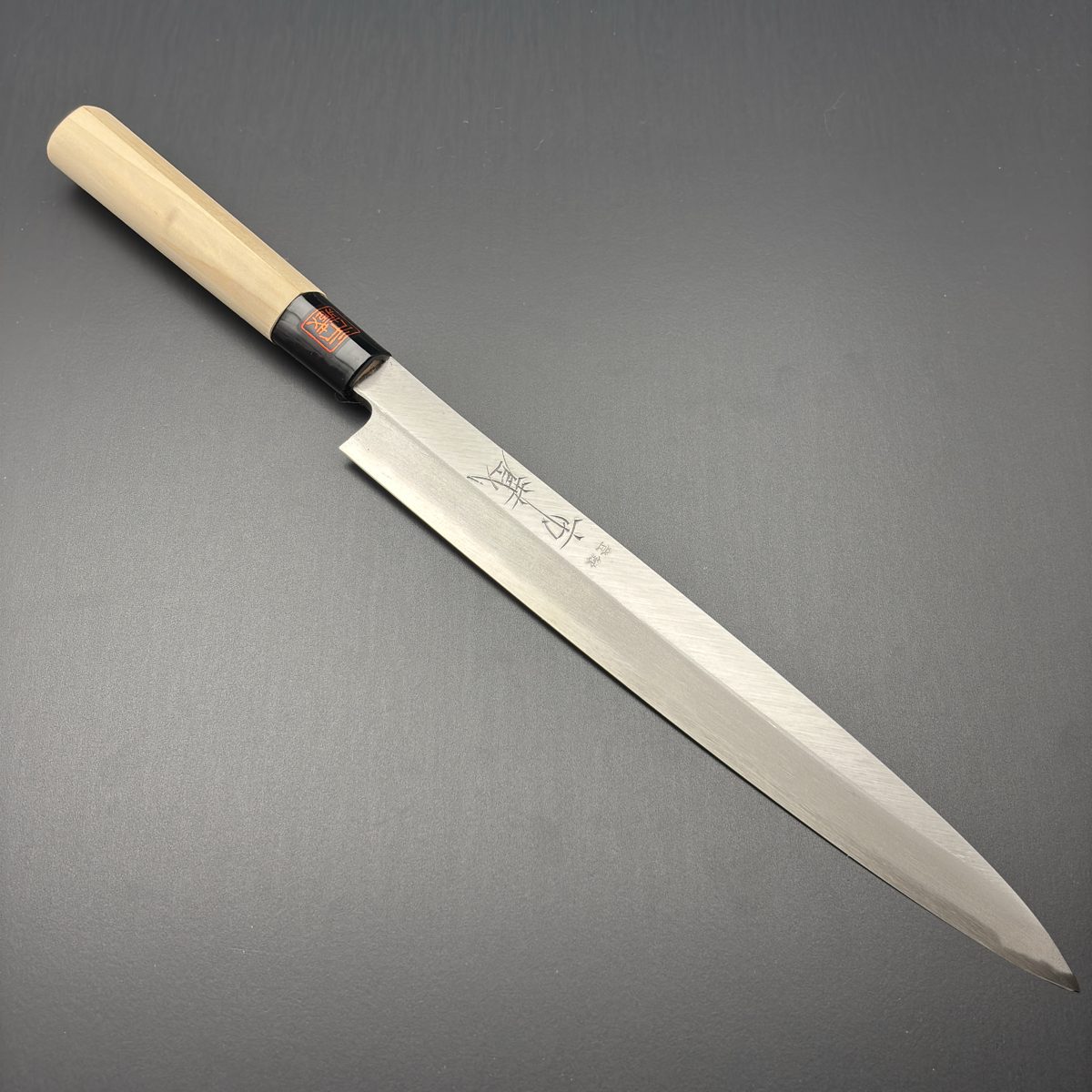
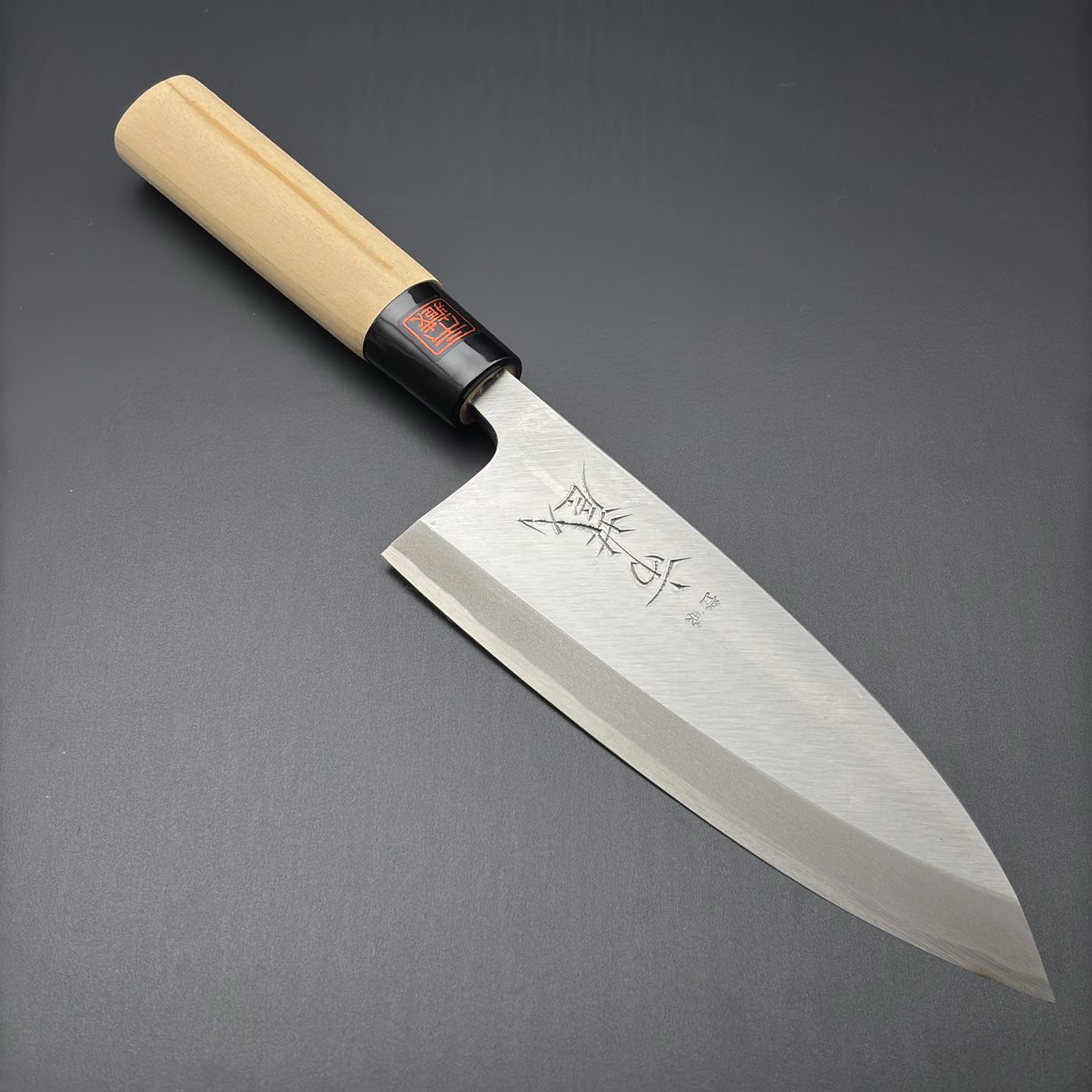
Shirogami is a cutlery steel in the Yasuki Hagane line, made by Proterial (formerly Hitachi Metals) in Yasugi, Shimane. It is a pure carbon steel, with impurities reduced as far as possible. It is easy to sharpen and takes a keen edge. Ichizo's yanagiba and deba are made of Shirogami.
It is often said the name comes from the white paper the steel was wrapped in when shipped, but we could not confirm this in the manufacturer's materials.
What "low impurities" means
Besides carbon, Shirogami's composition lists only silicon and manganese; no chromium or tungsten is added. Phosphorus is capped at 0.025% and sulfur at 0.004%. Kigami #2 (Yellow), with the same carbon, allows up to 0.030% phosphorus and 0.006% sulfur. In concrete terms, that gap is what "low impurities" means.
Yasugi and tatara steel
Yasugi was long a port town that shipped out the steel of the Izumo and Hoki regions. A company founded in 1899 to preserve this traditional steelmaking is the origin of today's Yasugi Works. But today's Shirogami is not made in a tatara. It is made with modern steelmaking, with its composition controlled.
#1, #2 and #3
The difference is the amount of carbon.
- #1: carbon 1.25–1.35%
- #2: carbon 1.05–1.15%
- #3: carbon 0.80–0.90%
More carbon is chosen for tools that need sharpness, less for tools that need toughness. It is not a ranking of quality. The manufacturer lists planes and razors among the uses for #1, and kitchen knives and saws among the uses for #3. Those are typical examples, though; in practice many kitchen knives are made from #2 and #1.
The hardness after quenching is given as HRC 60 or higher for every grade. That is the value for the material under the manufacturer's standard heat treatment. The hardness printed on a finished knife depends on how its maker heat-treated it.
Heat treatment shapes its character
How Shirogami is heat-treated changes the result a great deal. The manufacturer's catalog also says that however good the steel, its performance depends greatly on the quench. That is why Shirogami is called "a steel that shows the smith's skill."
The manufacturer's standard treatment for Shirogami #1 and #2 is to quench in water from 760–800°C and temper at 180–220°C. In the catalog's graph for Shirogami #2, water quenching gives nearly constant hardness across temperatures, while oil quenching gives much lower hardness when the temperature is low.
How single-bevel knives are built
Single-bevel Japanese knives such as the yanagiba and deba are traditionally made by forge-welding hard steel (hagane) onto soft iron (jigane). Shirogami is used as that hard steel. Double-bevel knives may use a three-layer build, with a Shirogami core between softer metal. If the outer layers are stainless, the sides resist rust, but the Shirogami core is exposed at the edge, and that part will rust.
Compared with Aogami and Ginsan
- Aogami (Blue): Shirogami with tungsten and chromium added, for better wear resistance
- Ginsan (GIN3): a stainless steel with 13–14.5% chromium, so it resists rust (see our article on Ginsan)
You often read that "Shirogami takes the keenest edge," but we could not find published data comparing them under the same conditions. None of them is simply "better"; they aim at different qualities.
Shirogami rusts
It contains no chromium, so it rusts if left wet. Under some conditions, rust can appear in about ten minutes (Kai). After use, wash it, wipe it dry at once, and let it dry. If you will not use it for a while, coat it thinly with cooking oil and store it somewhere dry. If you find rust, remove it early.
Who Shirogami suits
A Shirogami knife rewards the care you give it. It suits people who sharpen on whetstones themselves and do not mind wiping the blade after every use. It shines where the keenness of the edge shows directly in the work, such as slicing sashimi or breaking down fish. On the other hand, avoid cutting frozen food, chopping bones or prying with the blade. A thin, hard edge is weak against force from the side.
Names abroad
The manufacturer's official English designations are "Shirogami 1," "Shirogami 2" and "Shirogami 3." Shops abroad also say "White #2" or "White Paper Steel #2," and many pair them, as in "Shirogami #2 (White #2)." Including the grade number makes clear whether it is #1, #2 or #3.
Sources
- Proterial, YSS cutlery steel catalog (Japanese)
- Proterial, "Shirogami 1", "Shirogami 2", "Shirogami 3", "Shirogami Nokozai", "Kigami 2", "Aogami 2", "GIN 3"
- Proterial, company history (Japanese)
- Kai, FAQ on knife care and storage (Japanese)
- Tojiro, "Knife care" (Japanese)
- Sakai City, "Sakai Uchihamono" (Japanese)