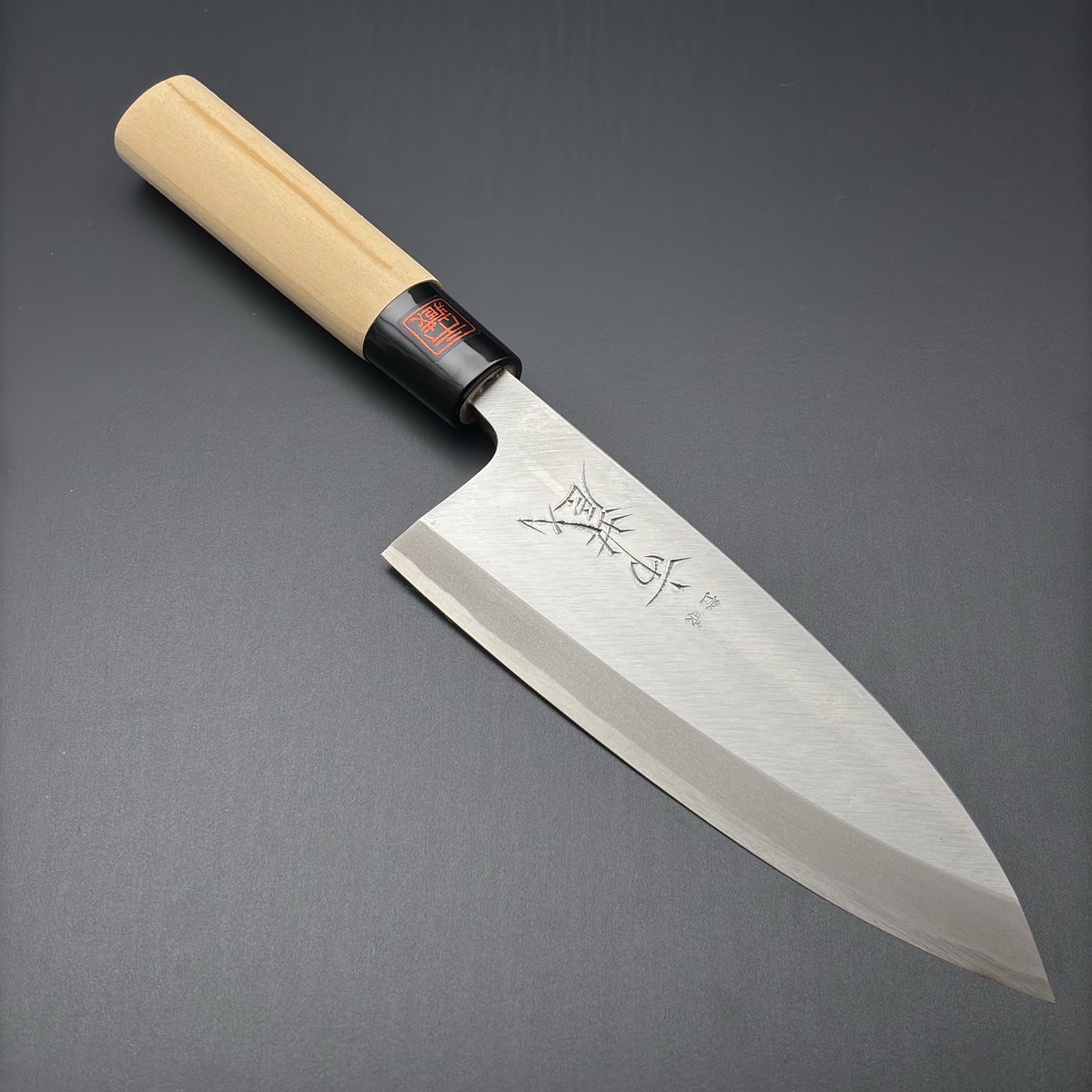
The New Year rice cakes are never cut with a knife. Many homes do not use a knife for the first three days of the year. Japanese New Year has several customs that keep blades at a distance, and yet the knife is the hardest-working tool in the kitchen at year's end. Here is the curious relationship between the Japanese New Year and the knife.
Opening, not cutting, the kagami mochi
The round rice cakes offered at New Year, kagami mochi, are taken down and eaten around January 11. This is called kagami biraki, "opening the mirror". It used to be held on the 20th; one account says it moved to the 11th because the 20th was the death day of Tokugawa Iemitsu, the third Edo shogun.
At kagami biraki the mochi is not cut with a blade. It is broken by hand or tapped apart with a mallet. In samurai households, men broke the mochi offered before their armor and women the mochi offered before their mirror stand, by hand or with a mallet.
The usual explanation is that for the samurai, cutting with a blade called seppuku to mind. "Breaking" was unlucky too, so they chose the word "open", which suggests things spreading wide and prospering. Even the word for breaking a rice cake was chosen with care.
Letting the knife rest for three days
Many regions also say you should not use a knife from January 1 to 3. The reasons vary. To avoid "cutting ties". To refrain from kitchen work with fire and water while the New Year deity is visiting. To let the person who cooks all year rest at least at New Year. The wording differs from house to house and place to place.
It is said that so many New Year dishes, osechi, keep well so that nobody has to stand in the kitchen during those three days.
That means the work has to be done before the year ends: vegetables trimmed for simmering, daikon shredded for namasu, fish filleted. Until New Year's Eve, the kitchen is where the knife works hardest all year. Resting it for three days comes after all that work.
A ceremony with only a knife and chopsticks
Japanese New Year is not only about keeping blades away. At court and samurai banquets, a ceremony called shiki-bocho has long been performed. A knife master in a court hat and robes cuts a fish using only a knife and long chopsticks, never touching it by hand. The cuts and the arrangement express good fortune; it is not food for eating.
The oldest school, the Shijo school, is said to go back to Fujiwara no Yamakage in the Heian period. Using a blade correctly was itself a form of celebration.
The blacksmiths' New Year
The people who make blades have a "New Year" of their own. In Miki, in the Banshu region where Ichizo Honpo is based, the Fuigo Matsuri (bellows festival) is held at Kanamono Shrine on the first Sunday of December every year. It gives thanks for the tools used every day and prays for a safe new year and better skill, and it is also called "the blacksmiths' New Year".
It is said to have begun in the Meiji era, when each smith held it at his own forge. After Kanamono Shrine was built in 1935, the smiths began to gather there. After the Shinto rite, craftsmen in traditional dress forge steel in a fire raised with bellows, and old blades brought in by local people are given a memorial service. In 2022 it became the first registered intangible folk cultural property of Hyogo Prefecture.
As the smiths close their year and give thanks to the fire, kitchens across Japan begin to prepare for New Year.
Sharpen before the year ends
Resting the knife at New Year is not a way of neglecting it. It works hard first, and then it rests. So sharpen your knives once at the end of the year. A sharp knife cuts daikon for namasu and decorative cuts for osechi without force.
In Japan, the idea of avoiding blades because they "cut ties" and the idea of giving them because they "cut open the future" have always lived side by side (see Giving a Knife). The New Year customs around the knife reflect both.