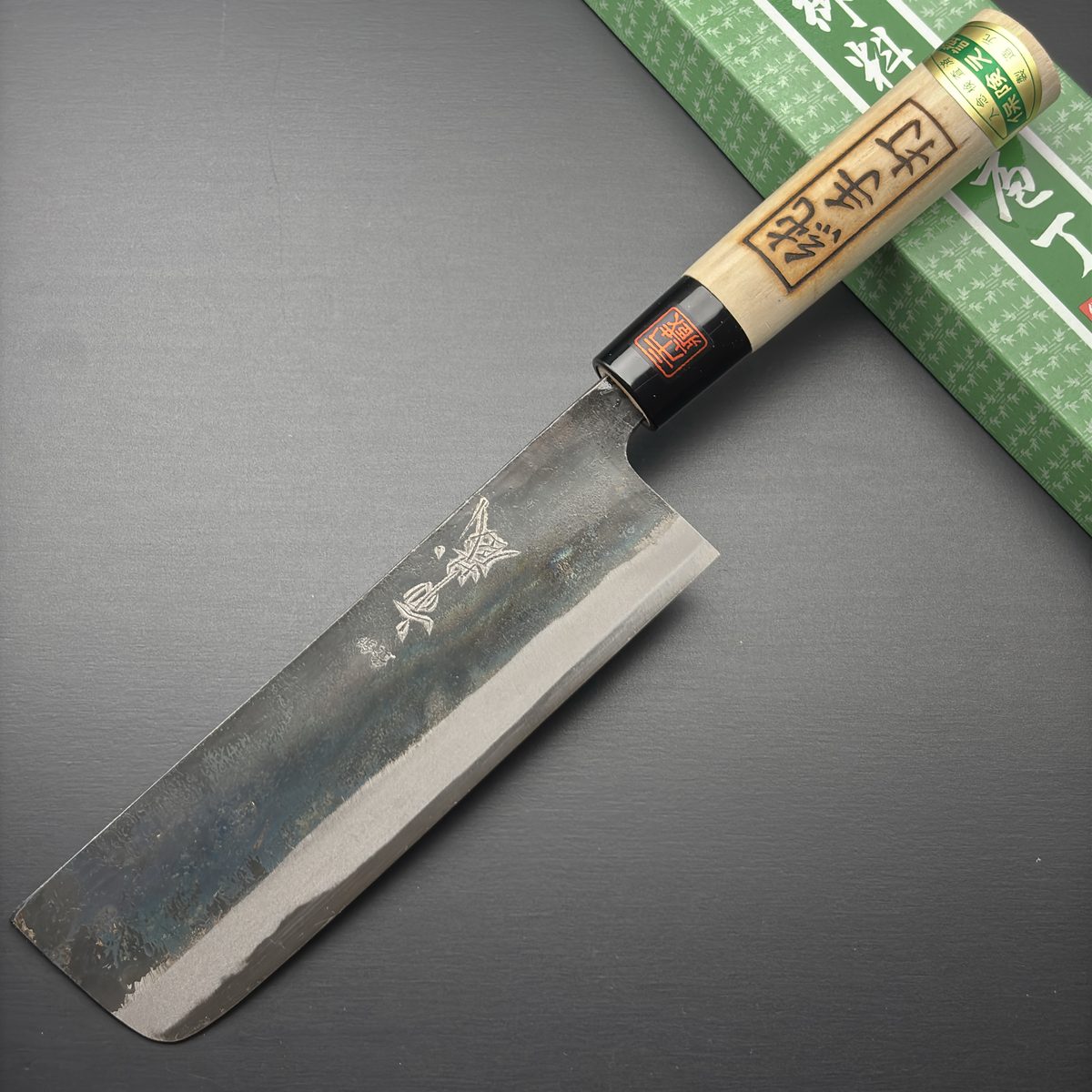
A square knife with no pointed tip. The nakiri is a Japanese knife made for cutting vegetables. Here is a short look at its shape, how to use it, and how to care for a kurouchi nakiri.
What a nakiri is
The nakiri (菜切包丁) is a knife for vegetables; in Japan it is also called a "vegetable-cutting knife". The blade is close to a rectangle and has no pointed tip. Most are double bevel, so they work for both right- and left-handed cooks (Kai).
Because the edge is almost straight, the whole edge meets the board at once. When you slice green onions or shred cabbage, you rarely lift the knife to find pieces still joined together. The tall blade also lets you carry chopped food to the pot.
The nakiri Ichizo Honpo has handled have mostly had blades of 160 to 170mm.
How it differs from a Chinese cleaver
It looks like a Chinese cleaver, but the nakiri is a Japanese knife with a long history in Japan. The difference is thickness and weight: a nakiri is thinner and lighter (Kai). The three kurouchi nakiri we handled most recently weighed between 135 and 170g.
Do not use it to chop through bone the way you would a cleaver. A thin blade is weak against sideways force and hard impacts. It is also not suited to meat and fish (Kai).
How to use it
Bring the blade straight down onto the board, or push it slightly forward as it comes down. Since the edge is straight, the whole edge lands almost at once and the cuts come out even. Curl the fingertips of the hand holding the food and rest your knuckles against the side of the blade; this makes it easier to keep slices the same thickness.
With hard vegetables such as daikon or squash, do not twist the blade while it is buried deep. Work the blade in a little at a time and press down on the spine with your other hand. To gather chopped food, scoop it up with the side of the blade instead of scraping the edge across the board.
Tip shapes
Not every nakiri has the same tip. Some stay square with a sharp corner right to the end; others have the corner rounded off. Shapes are sometimes named after a place, and among the knives Ichizo Honpo has handled are shapes called "Kyushu style" and "Takefu style".
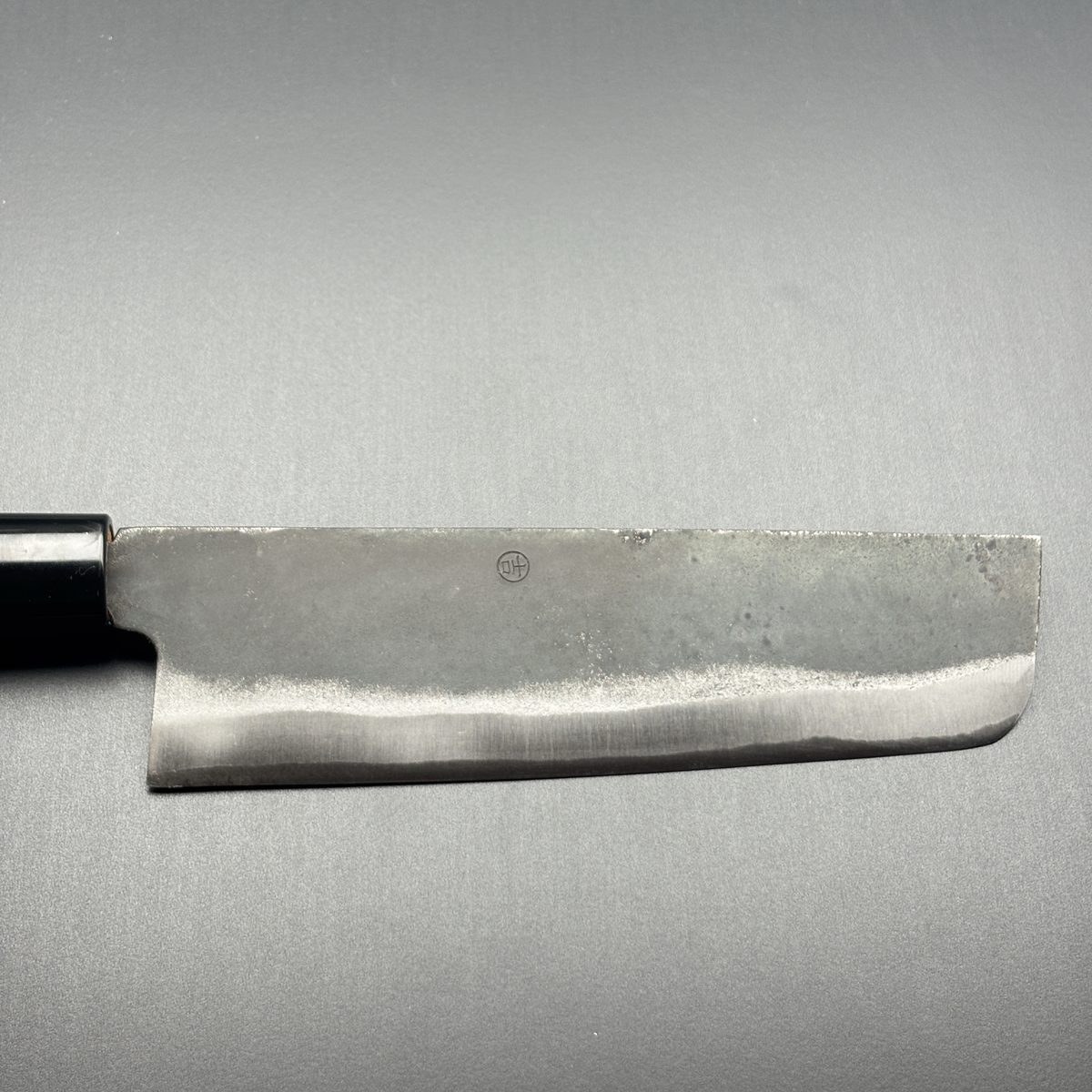
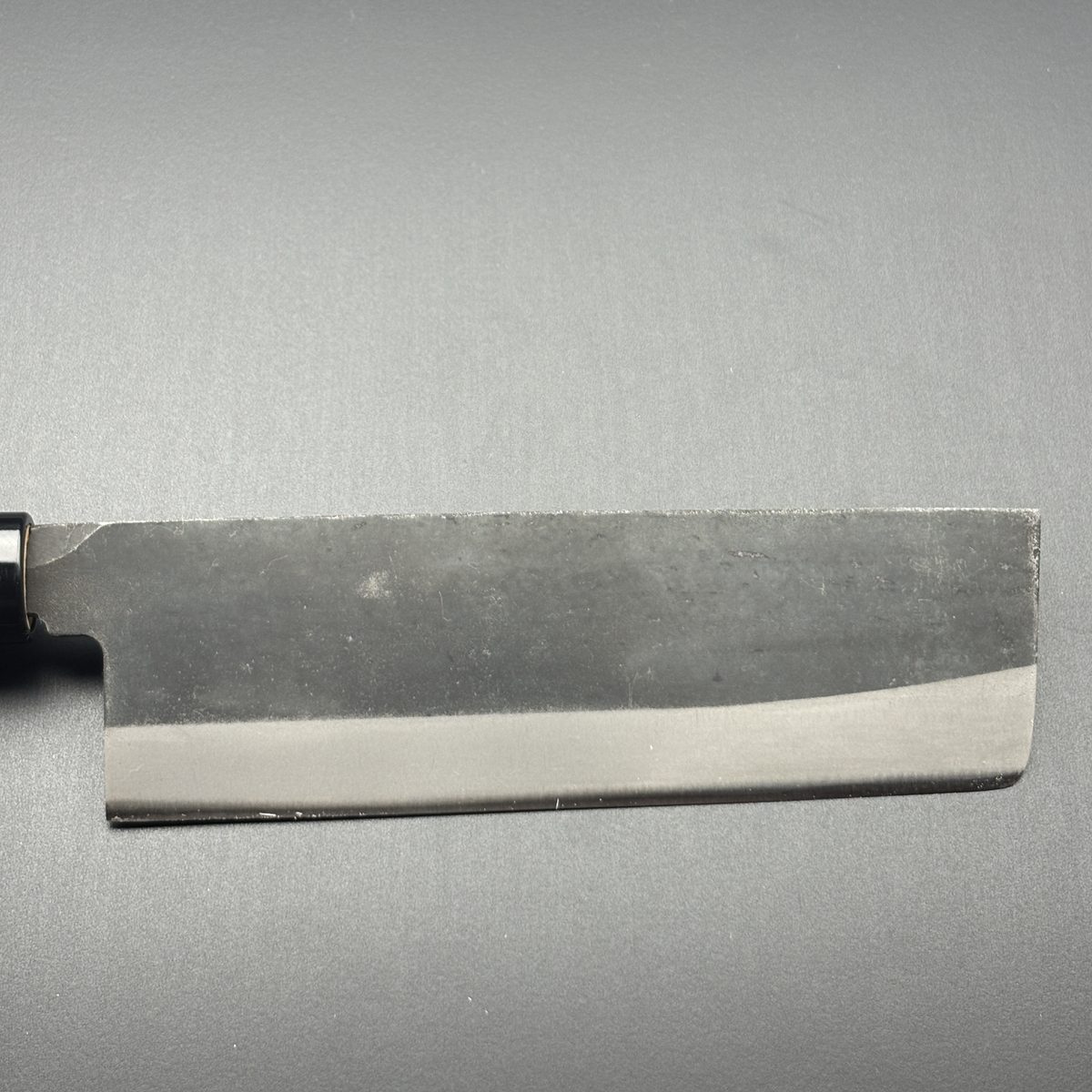
Kurouchi and warikomi
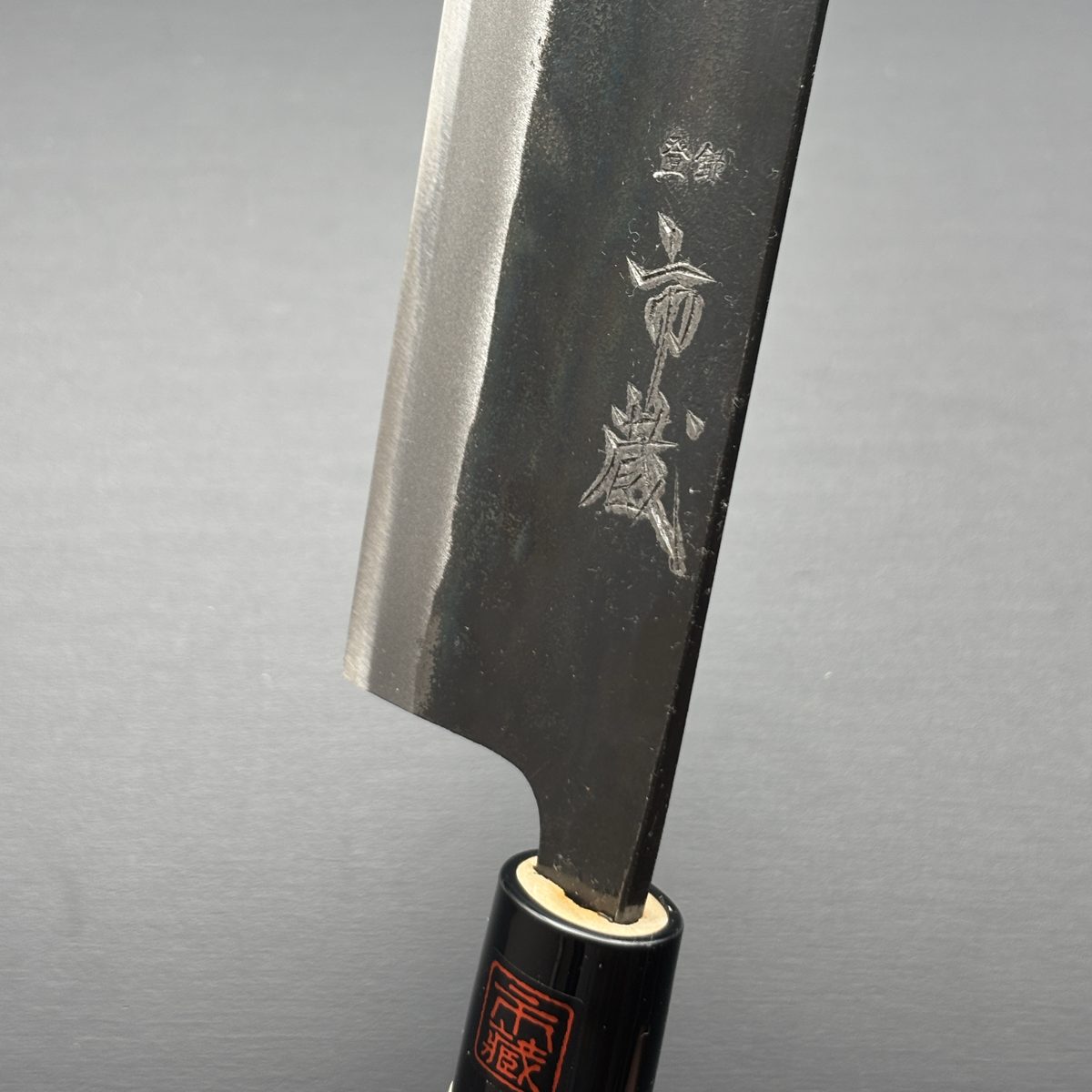
All the nakiri in these photos have a kurouchi (black) finish. The dark skin left from forging is kept on the upper part of the blade. Only the area near the sharpened edge is bright.
The Ichizo nakiri is warikomi blue steel: a core of hard blue steel (Aogami) is clad on both sides with soft iron, and the blue steel is exposed at the edge. Aogami is Shirogami with tungsten and chromium added (see our Shirogami article).
Care
Carbon steel rusts, and so do the dark skin and the iron cladding. After use, wash it, wipe it dry right away and let it air. If you will not use it for a while, coat it with a thin layer of cooking oil and keep it somewhere dry (Kai, Tojiro).
Do not leave it wet on the board or in the sink. Wash it promptly after cutting salty or acidic food such as pickles or citrus. The color of the blade will change little by little with use. If red rust appears, remove it early.
The dark skin wears away slowly from the edge side as you sharpen. A bright band that grows wider over the years is a sign the knife has been sharpened and used.
When sharpening, keep the edge straight. If you sharpen the heel or the tip more than the rest, the middle becomes hollow and part of the edge no longer touches the board.
What to look for
- Length: is it too long for your cutting board?
- Steel: carbon steel is easy to sharpen but needs care. If you want rust resistance, choose stainless (see our Ginsan article)
- Edge: even a double-bevel blade may be sharpened more on one side. Left-handed cooks should check
- Weight: a lighter knife tires the hand less; a heavier one lets its weight work on hard vegetables
Who a nakiri suits
It suits people who cut a lot of vegetables and want even shreds and slices. It fits a cutting style of bringing the blade straight down or pushing it forward. It is not made for rocking the blade on its tip.
If you also cut meat and fish, keep a santoku or gyuto alongside it. The nakiri works best as a second knife that takes on the vegetable work.
Names
Outside Japan it is simply called a "nakiri", often written "nakiri knife" or "Japanese vegetable knife". Kurouchi and warikomi are also used as they are.