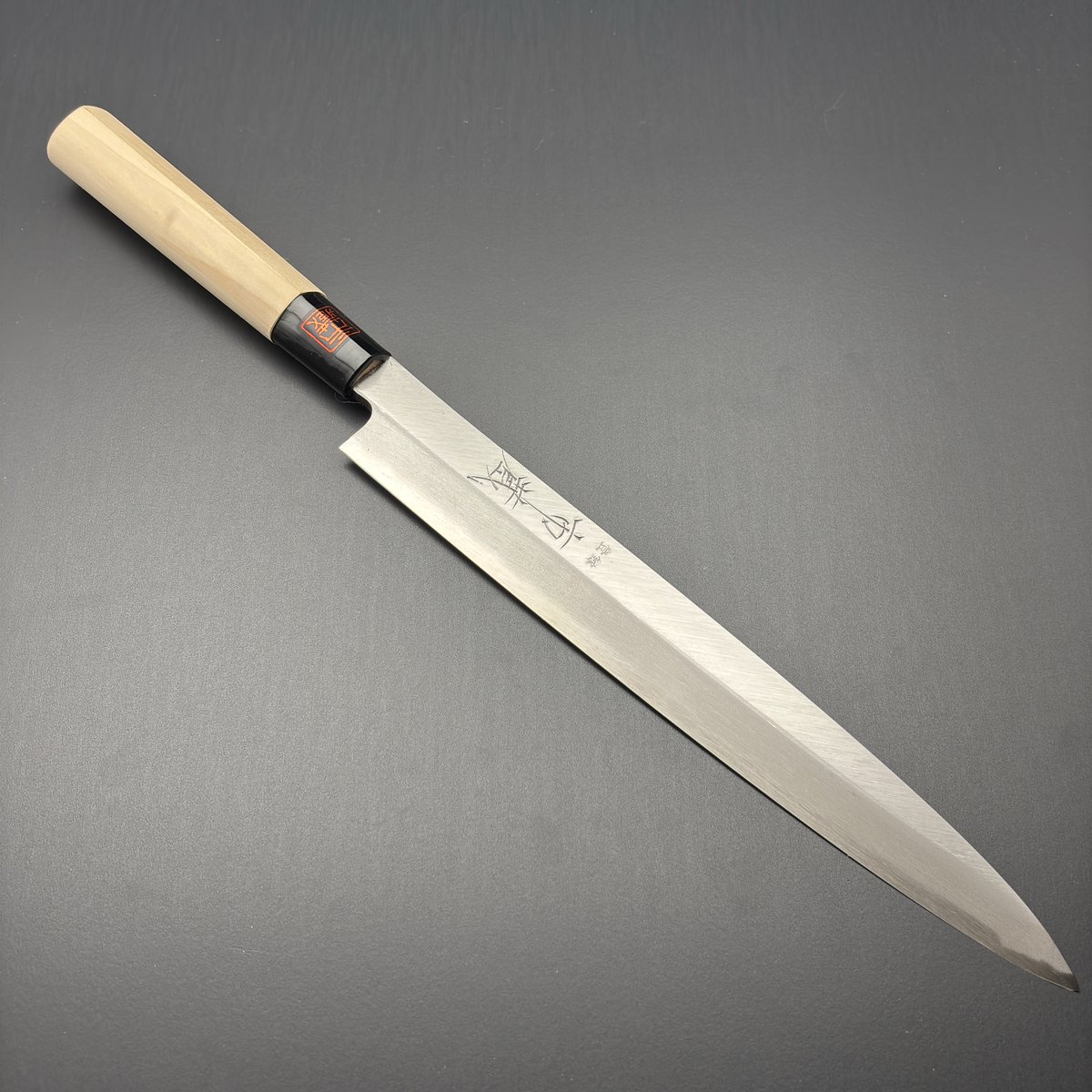
Take the handle off a Japanese sword and you will find characters cut into the tang, the part hidden inside the grip. Many Japanese kitchen knives also carry characters near the heel of the blade. This inscription is called the mei. Rules about putting names on blades in Japan go back to the 8th century. What have these few characters been telling us?
The mei goes on the outer face
On a Japanese sword, the mei is cut into the tang with a small steel chisel called a tagane. It is the last job the swordsmith does, and it has its own name: meikiri, cutting the mei.
Which side gets the name is fixed. The face that sits on the outside when the sword is worn is the front, and the maker's name goes there, sometimes with his home province or the place he worked. A signature of the name alone is called a niji-mei, a two-character mei; one that adds the province and place is a naga-mei, a long mei. The back usually carries the date of making, or the owner's name. A tachi was hung from the belt edge down, while the later katana was thrust through the sash edge up, so the outer face is on opposite sides for the two. After the katana spread in the Muromachi period (1336 to 1573), signing on the katana side became the norm.
A name required by law
The Taiho Code of 701, Japan's early legal code, included a rule that newly made weapons should carry the name of the person who made them. Yet every sword that survives from that age is unsigned.
By the Kamakura period (1185 to 1333), more and more blades added a place of residence or a year to the name. In the 14th century, when two rival imperial courts ruled Japan, swords were dated with the era names of one court or the other. Today those dates help show which region followed which court.
Keeping the name alive
Long swords were often shortened later in their lives. This is called suriage. The tang is cut back from its end, so when a blade is shortened a lot, the mei disappears with it. Many swords from the 14th century lost their signatures this way.
People still found ways to keep the name. In an orikaeshi-mei, the signed part of the tang is folded over to the other side. In a gaku-mei, the signature is cut out as a small plaque and set into the new, shorter tang. When an expert judged who made an unsigned sword, the attribution was written on the tang in red lacquer, or inlaid in gold.
Where there is a name, there are fakes
Once a name has value, someone will forge it. A false signature cut by someone other than the maker is called gimei. There is also daimei: a smith's son or pupil who helped forge a blade could sign it with the master's name, with the master's approval. That was not treated as forgery.
By the late 15th century, families had appeared whose trade was to identify a sword's maker and judge whether it was genuine. The best known, the Hon'ami family, served as official appraisers to the shogunate in the Edo period and issued certificates called origami stating a sword's value. The file marks on the tang, called yasurime, also differ by school and smith, and they too help judge whether a sword is genuine. A mei is important evidence, but it does not settle authenticity by itself.
Reading the mei on a kitchen knife
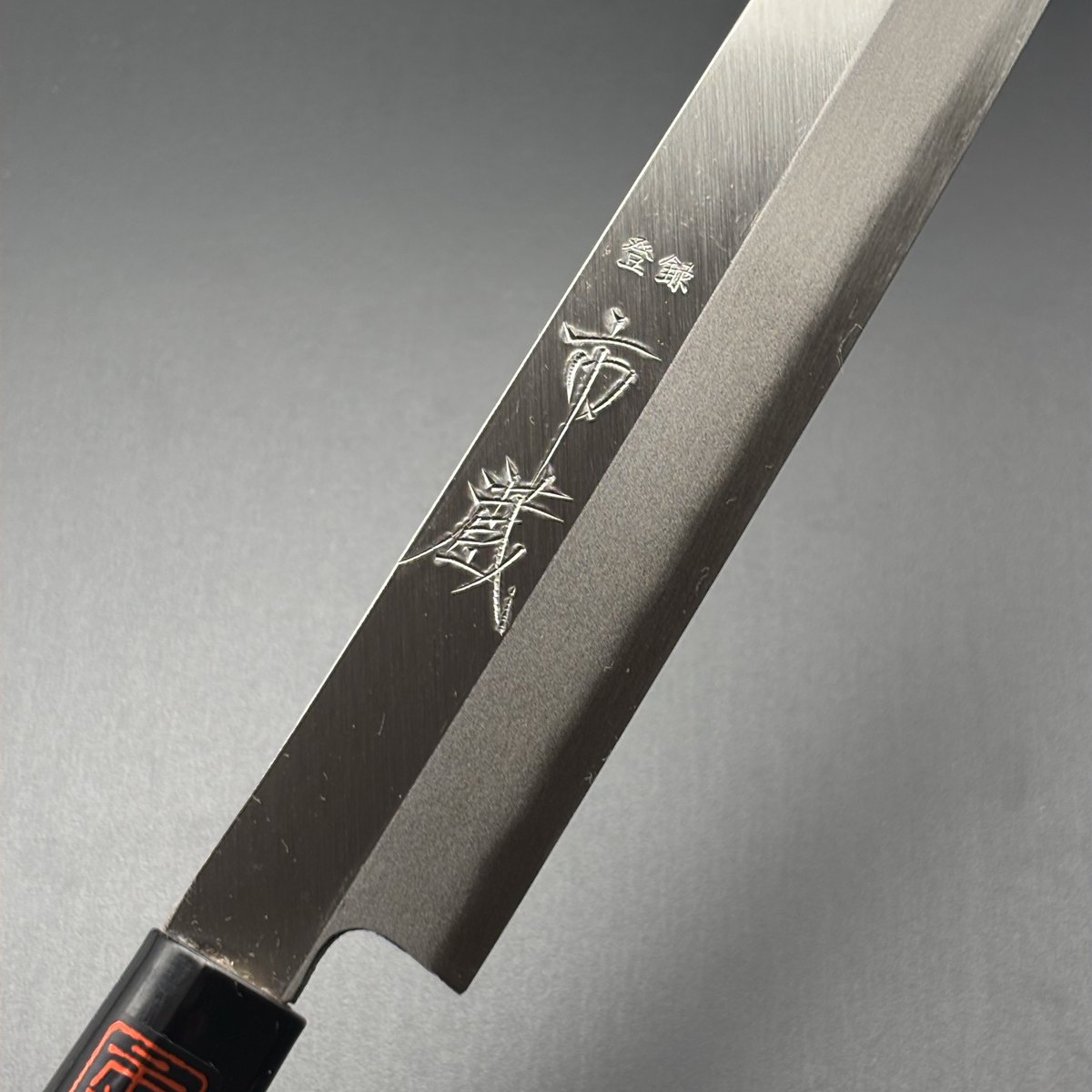
On a kitchen knife, the mei sits on the side of the blade, close to the handle. A sword's mei named the smith. A kitchen knife's mei is more often a shop name or a brand, and it is not always the name of the person who made it. The Ichizo on our knives is a brand name.
Even so, it is still useful. Once you know where a knife came from, it is easier to buy another in the same shape, or to ask for sharpening or repair. For how swordsmiths and the smiths who made everyday blades went separate ways, see Swordsmiths and Village Smiths.
Look at the mei on your own knife
Pick up a Japanese knife you own and look near the heel of the blade. If there are characters there, that is the knife's name. If you cannot read them, take a photo and ask the shop where you bought it. They can often tell you where it came from.
Knowing that makes it easier to have the knife sharpened or rehandled later. The mei is a small clue that helps one knife stay in use for a long time.