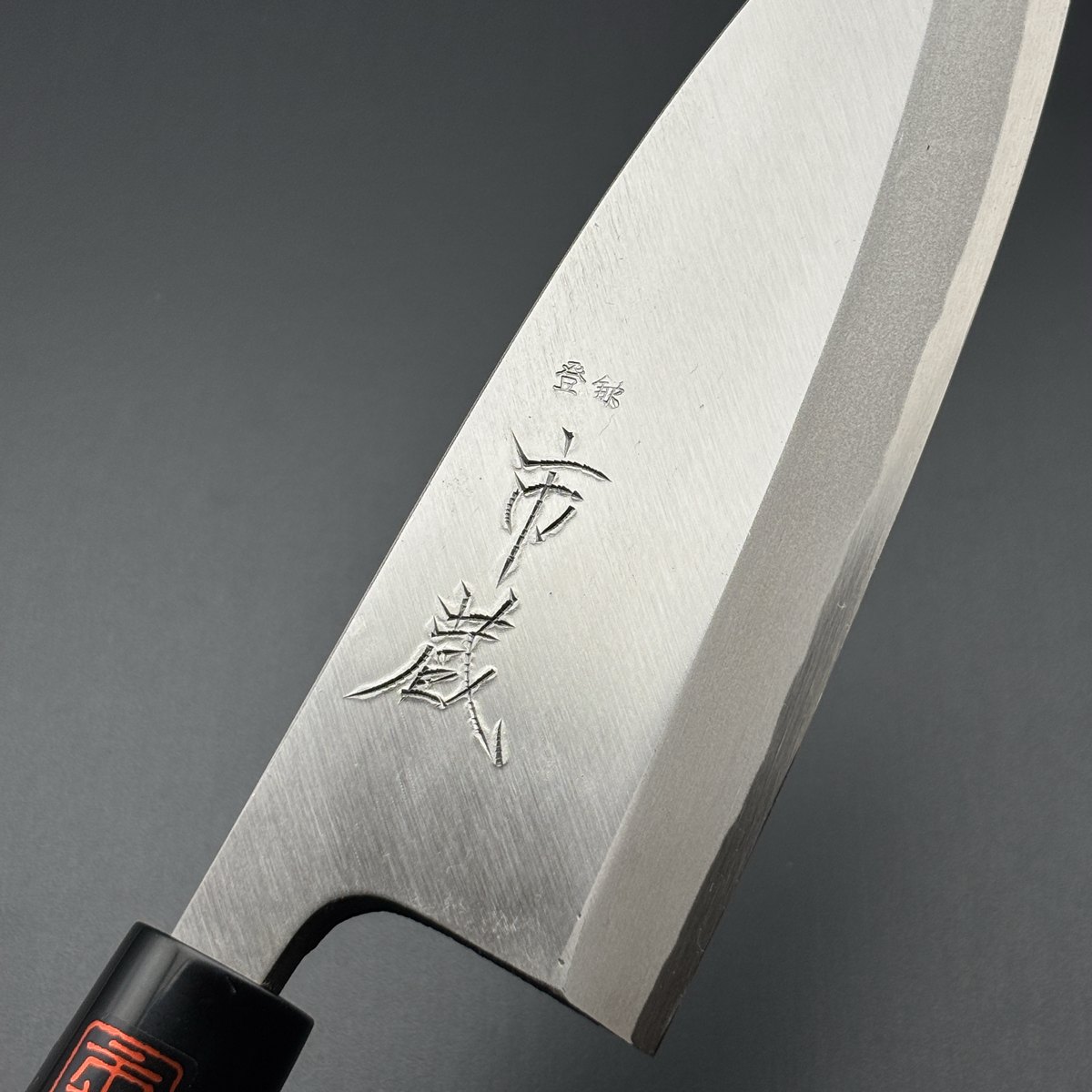
The deba and the sashimi knife are usually single-bevel: the edge is ground on one side only. Yet the santoku, the knife found in most Japanese homes, is double-bevel. Why do Japanese knives split this way? The answer runs through language and the history of the sword.
Katana means single edge
In Japan, blades have been named as single-edged or double-edged since the Nara period. The word katana itself comes from this. Na is an old word for a blade's edge, and a katana is a blade with its edge on one side.
The Wamyo Ruijusho, a dictionary from the mid-Heian period, defines a to, a sword, as a blade like a ken but with one edge, and a ken as a blade like a to but with two. An inventory of offerings to Todaiji temple in 756 records a long sword whose point was single-edged.
Swords to cut, blades to thrust
The single-edged sword is described as a weapon suited to cutting, and the double-edged blade as one suited to thrusting. In Japan, bronze double-edged blades came into use in the Yayoi period. In the early Kofun period both iron double-edged blades and iron swords existed, but by the late Kofun period nearly all were swords.
All of these were straight. Once the curved Japanese sword appeared around the middle of the Heian period, weapons became almost entirely single-edged, and the double-edged blade fell out of real use.
From small knives to the hocho
Kitchen blades began as small knives called tosu. The Engishiki of 927 lists 77 of them a year for the office that prepared the emperor's meals, including ten for opening oysters and two for cutting abalone.
In time, a cooking blade came to be called hocho-gatana, the cook's sword, and then simply hocho. An early example appears in the Konjaku Monogatari, a collection of tales from the late Heian period. An early Edo-period record of Kyoto notes that any blade used in the kitchen to cut fish or meat, large or small, was called a hocho. The deba appeared in the Muromachi period, and a guide of 1638 lists the deba of Izumi, near today's Sakai, among the famous products of the provinces.
How the two are made
Most steel kitchen knives are made by joining hard steel and softer steel. In a double-bevel knife, the hard steel sits in the middle, sandwiched by softer steel on both sides. In a single-bevel knife, softer steel is joined to only one face of a thin layer of hard steel. The difference is built in at the forge, not only at the sharpening stone.
The deba and the sashimi knife are usually single-bevel. The deba has a thick spine and a pointed tip, and is used to break down fish and poultry. The sashimi knife is long and narrow. Vegetable knives are divided: the usuba used by professional cooks is single-bevel, while the nakiri used in homes is double-bevel.
The double bevel comes home
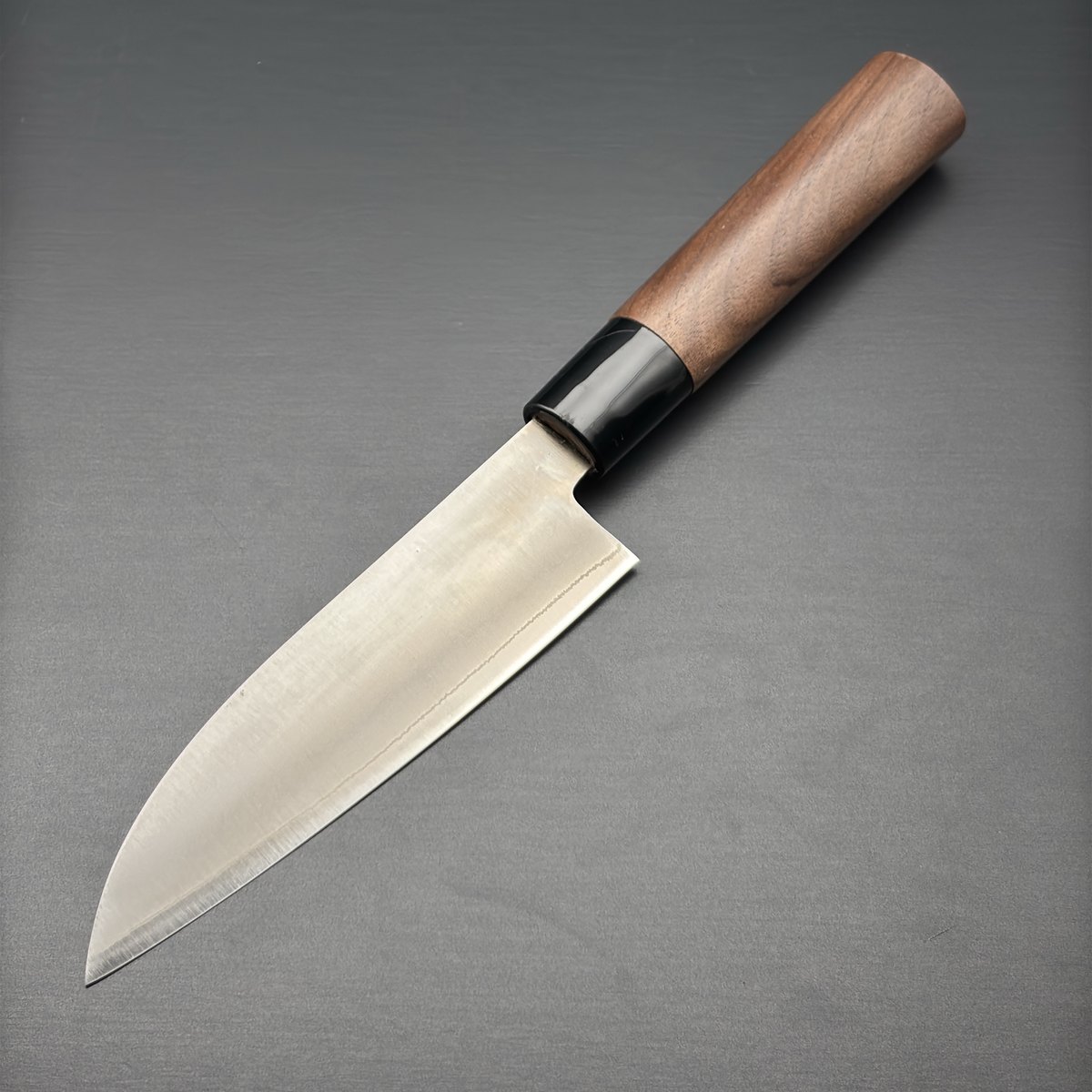
From the Meiji era, Western knives arrived for cutting meat: the gyuto, or beef knife, and the small petty knife for peeling. Later came the bunka knife, which combines the strengths of the nakiri and the gyuto. Also called the santoku, it handles meat, fish and vegetables.
The bunka knife is double-bevel and easy to handle, and most are stainless steel. It became the standard knife of the home kitchen. Single-bevel knives for the professional, double-bevel knives for the home: both traditions live on in Japanese kitchens today.
Choosing a single-bevel knife
A single-bevel knife has its edge on a set side, and knives for right-handed and left-handed users are ground on opposite sides. If you are left-handed, check that the knife is made for the left hand.
If you keep only one knife at home, a double-bevel santoku or nakiri works for either hand. If you want to break down fish, add a single-bevel deba. For more on the deba and yanagiba, see Knives for Fish. For the stones used to sharpen them, see Japanese Whetstones.